Circé. Stay in control of every AI system you run.
Circé inventories your AI systems, proposes their qualification under the AI Act, tracks the obligations to handle and keeps a record of every decision. The rules are explicit. The decision stays human.
- Qualification based on a versioned AI Act framework (grid GRILLE-AIA-2026.10)
- Expert review available from the KIND network
- Register and audit trail exportable as CSV, system file as PDF
Screenshots of the Circé platform, with demonstration data (fictitious organisation).
Using AI is fast. Knowing what you do with it is much slower.
For an SME or a mid-cap, the point is not to write more documentation. It is to know which systems are running, which ones the AI Act concerns, and who has to do what.
AI systems nobody has listed
Tools picked by business teams, AI features switched on in existing software, internal prototypes: nobody has the full list.
Obligations that are hard to place
Depending on its use, the same tool can be minimal risk or high risk. Each system has to be qualified before you know what to do.
Scattered evidence
Decisions, supporting documents and approvals live in emails and files. At the first audit or tender, everything has to be rebuilt.
One platform to map, qualify, act and prove.
Circé covers the full life cycle of an AI system inside the organisation, from declaration to audit evidence, with a KIND expert in the loop when needed.
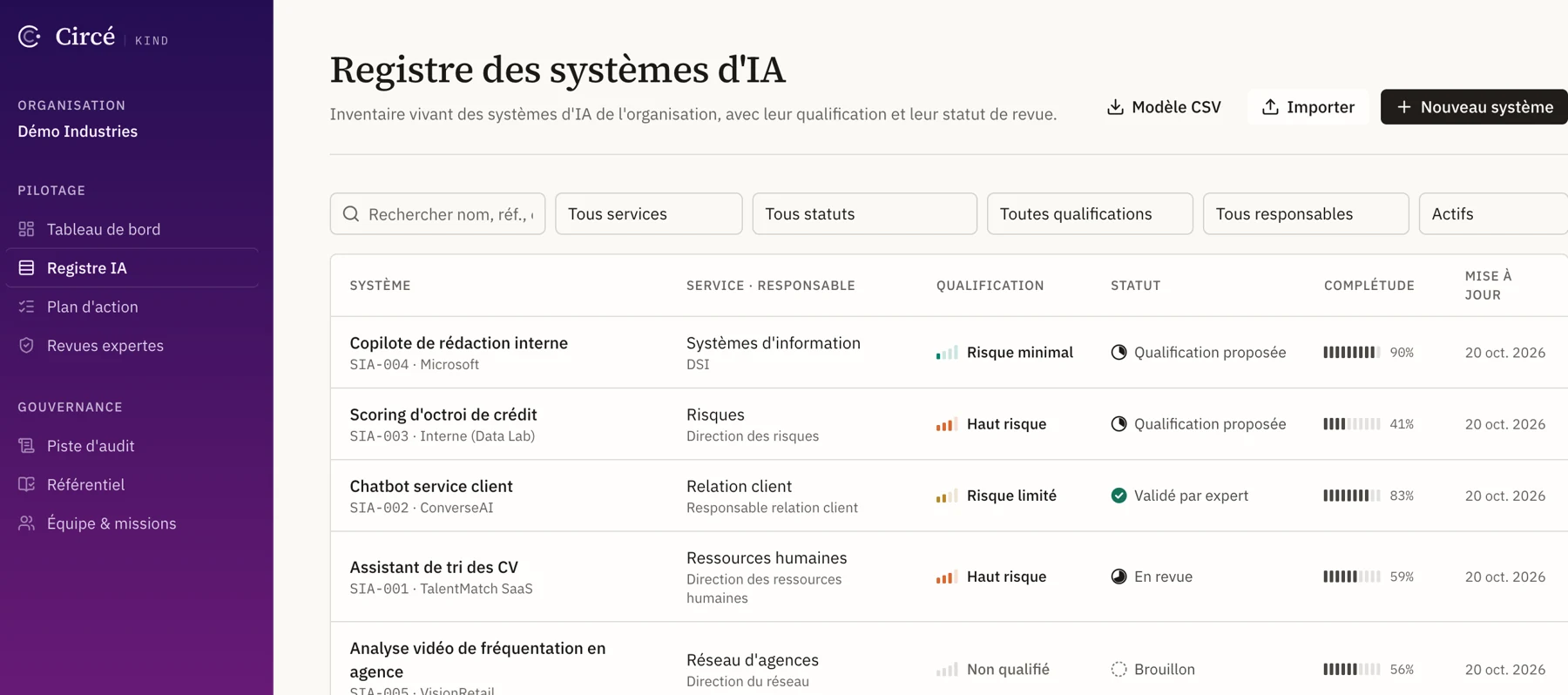
A living register of all your AI systems
Each AI system in the organisation has its own record: identifier, vendor, version, department, owner, life-cycle stage. You see at a glance what is qualified, under review or still a draft.
- Search and filters by department, status, qualification and owner
- Completeness rate shown for each system
- CSV import with a template provided, to get started fast
- Last update date visible on every row
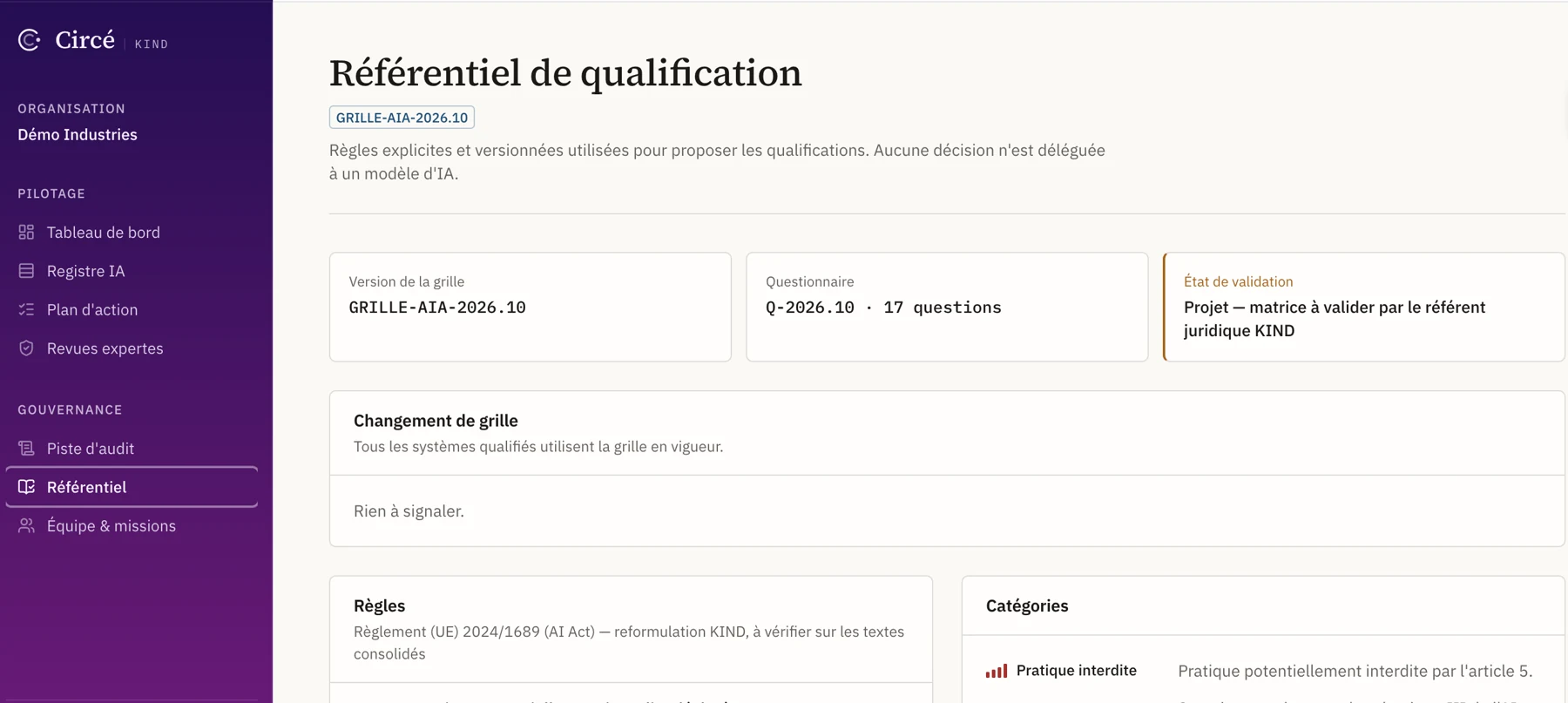
A qualification proposed by explicit rules
A 17-question questionnaire describes how the system is used. Circé applies readable, versioned rules to propose a level: prohibited practice, high risk, limited risk or minimal risk. No decision is handed to an AI model.
- Versioned framework (grid GRILLE-AIA-2026.10, questionnaire Q-2026.10)
- Each rule tied to an article of Regulation (EU) 2024/1689
- Grid changes flagged on systems already qualified
- Uncertain qualification: confirmation by a KIND expert required
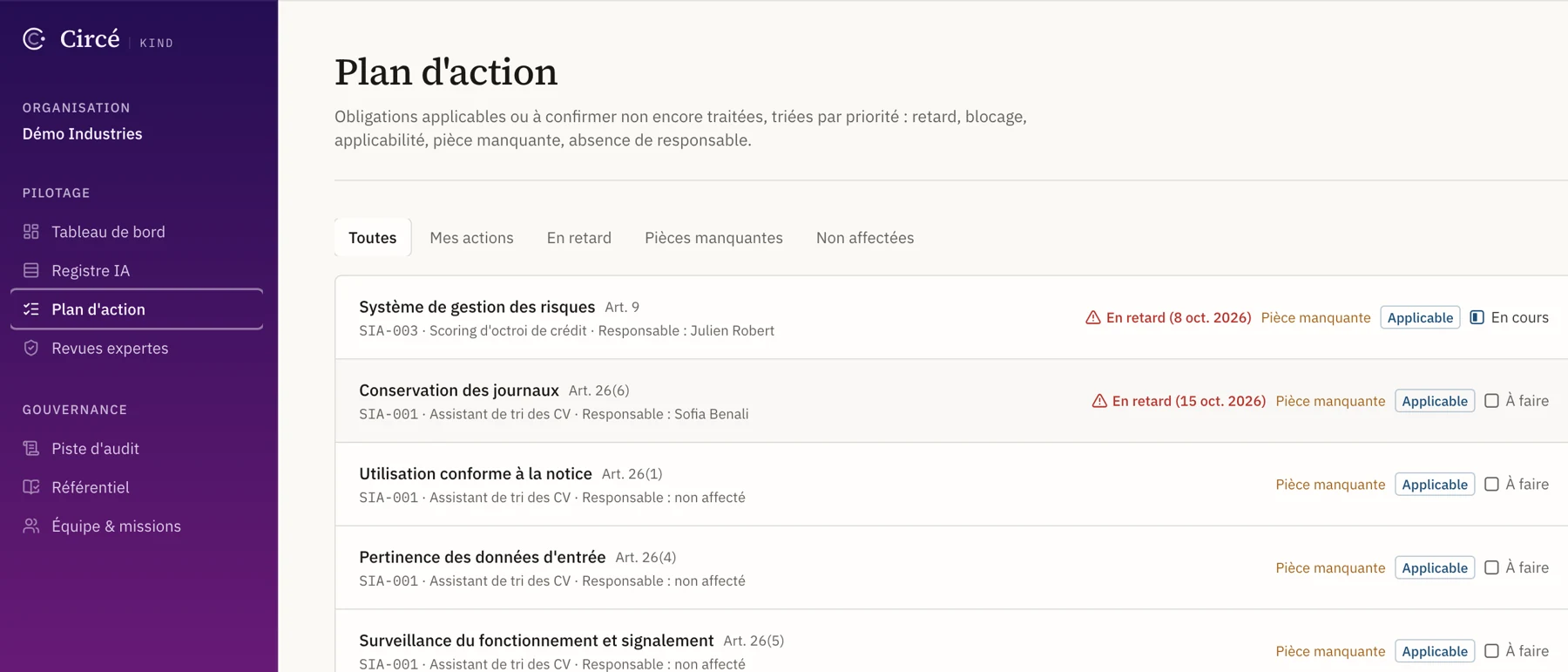
An action plan sorted by urgency
For each system, Circé lists the obligations that apply or need confirming, with their legal reference, deadline and owner. The plan puts what is late, blocked or missing a supporting document first.
- Views: all, my actions, late, missing documents, unassigned
- Obligations tied to an article (Art. 9, Art. 26 and following)
- Status per action: to do, in progress
- Owner and deadline shown for each obligation
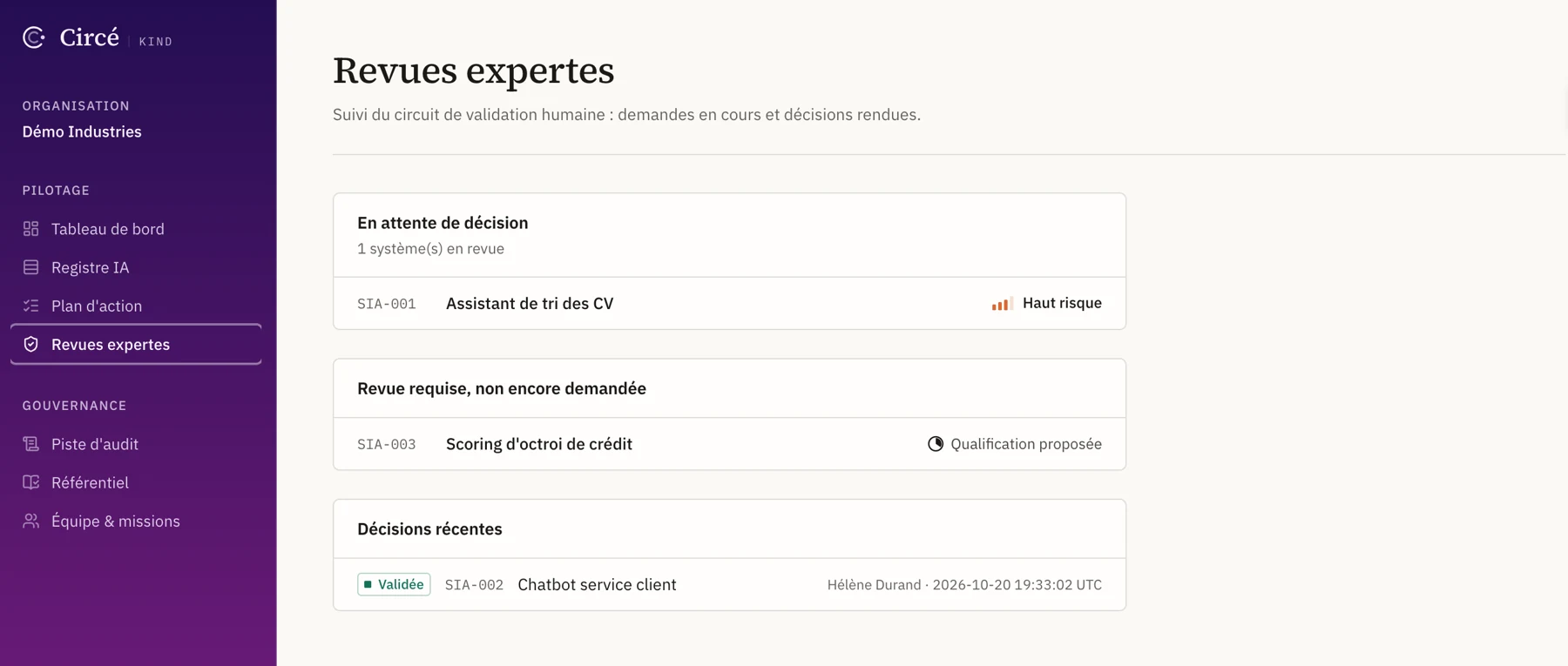
A human validation circuit
Sensitive qualifications go through an expert. Circé tracks review requests in progress, reviews required but not yet requested, and decisions made, with the reviewer's name and the date.
- Systems awaiting a decision, by risk level
- Reviews required but not yet requested, flagged
- Recent decisions, dated and named
- Visible reminder: Circé proposes, it does not replace legal advice
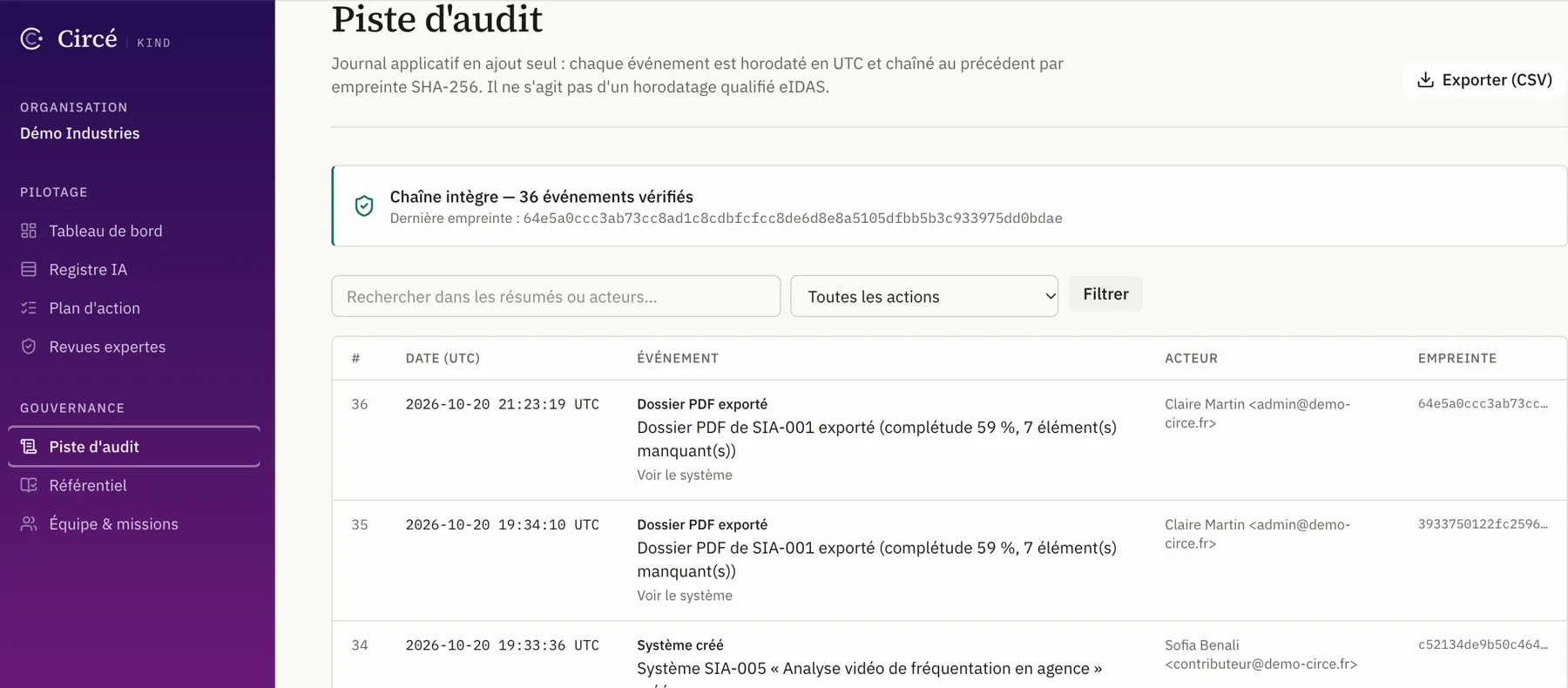
A chained, exportable audit trail
Every event is timestamped in UTC and chained to the previous one by a SHA-256 fingerprint. You check the chain's integrity, find an action or an actor, and export the log. It is not an eIDAS qualified timestamp.
- Chain integrity check in one click
- Search across summaries and actors, filter by action type
- PDF file per system, with completeness and missing items
- CSV export of the log
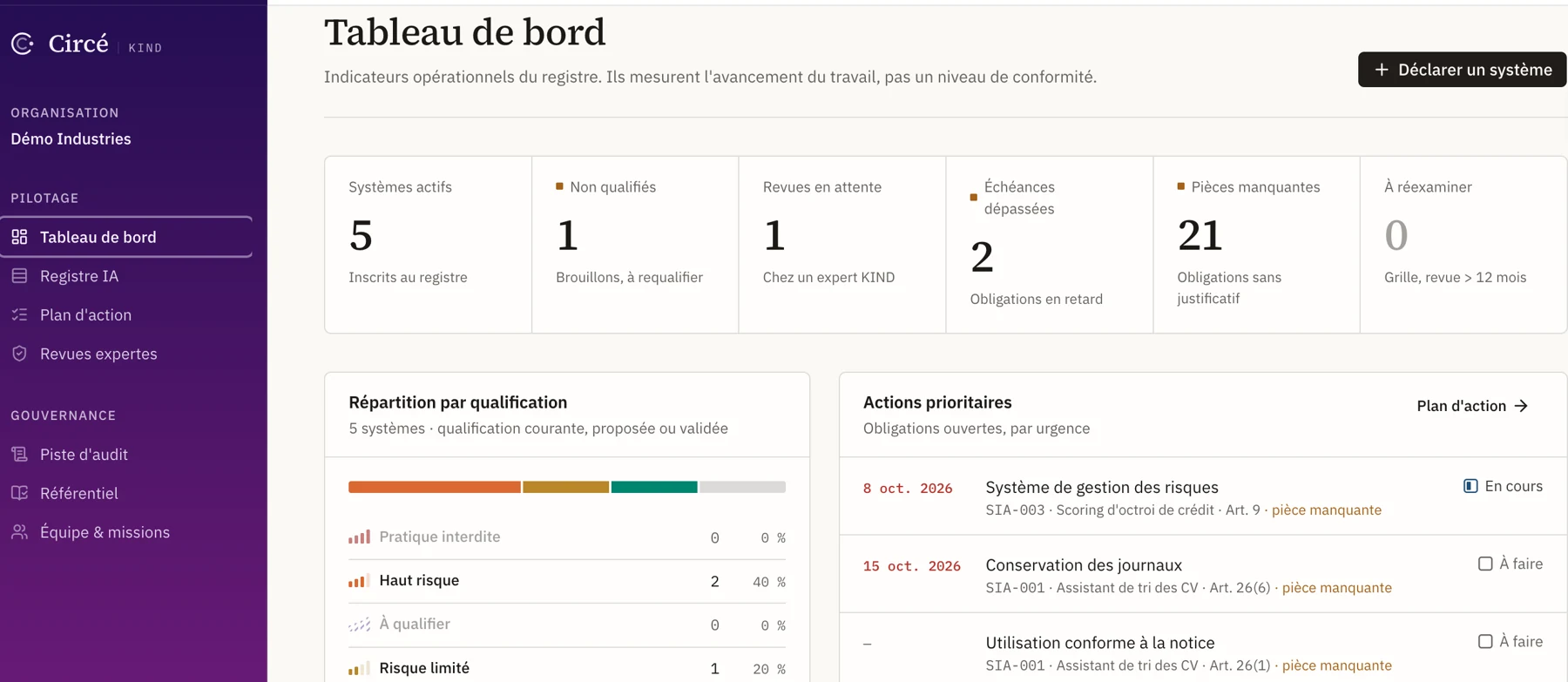
A dashboard that measures work progress
Active systems, unqualified, reviews pending, overdue deadlines, missing documents, systems to re-examine: Circé's indicators measure work progress, not a compliance level.
The breakdown by risk level and the priority action list tell you where to start.
- Systems broken down by AI Act qualification
- Priority actions ranked by deadline
- Direct access to the action plan and to declaring a new system
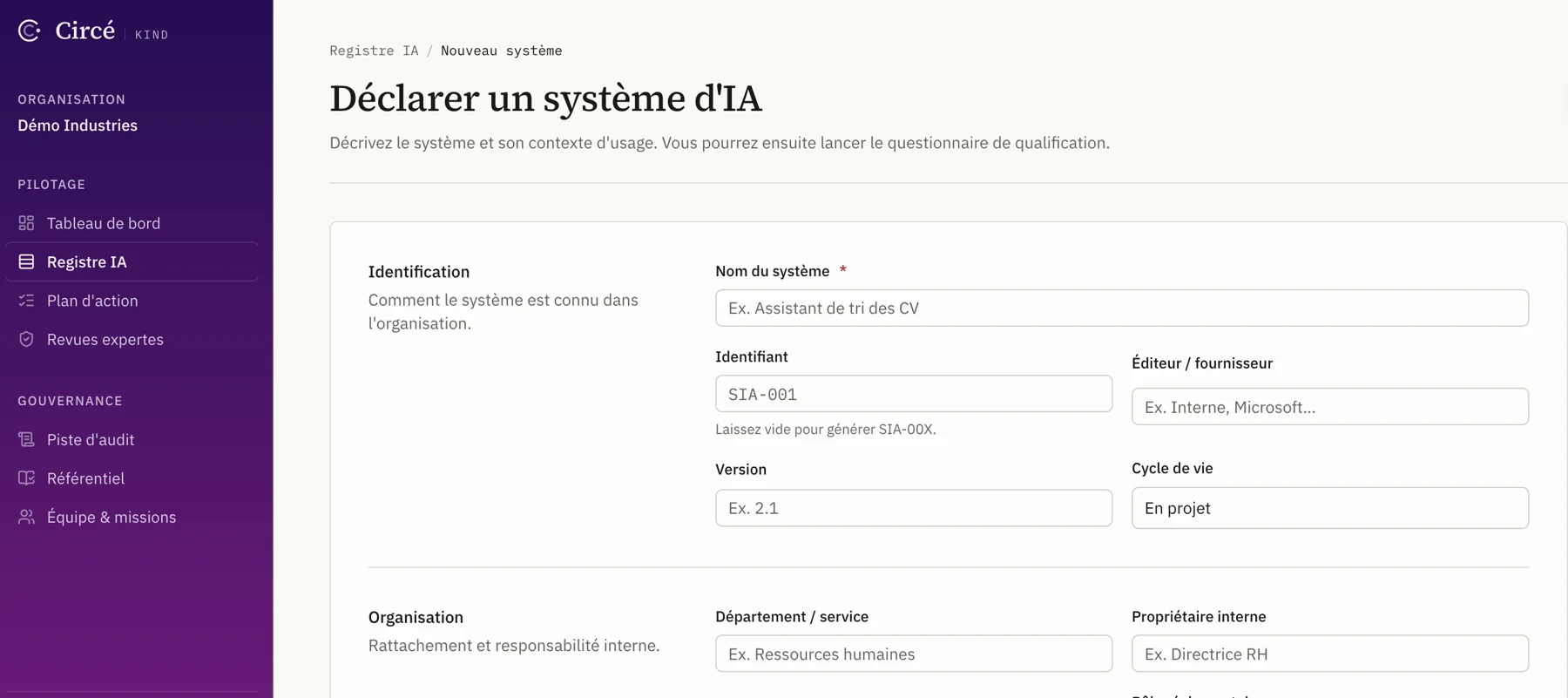
Declare an AI system in a few minutes
A guided form describes the system and its context of use. You then launch the qualification questionnaire.
- Identification: name, automatically generated SIA-00X identifier, vendor or supplier, version, life-cycle stage
- Organisation: department or service, internal owner, go-live date
- Regulatory role to specify (provider, deployer), then the qualification questionnaire
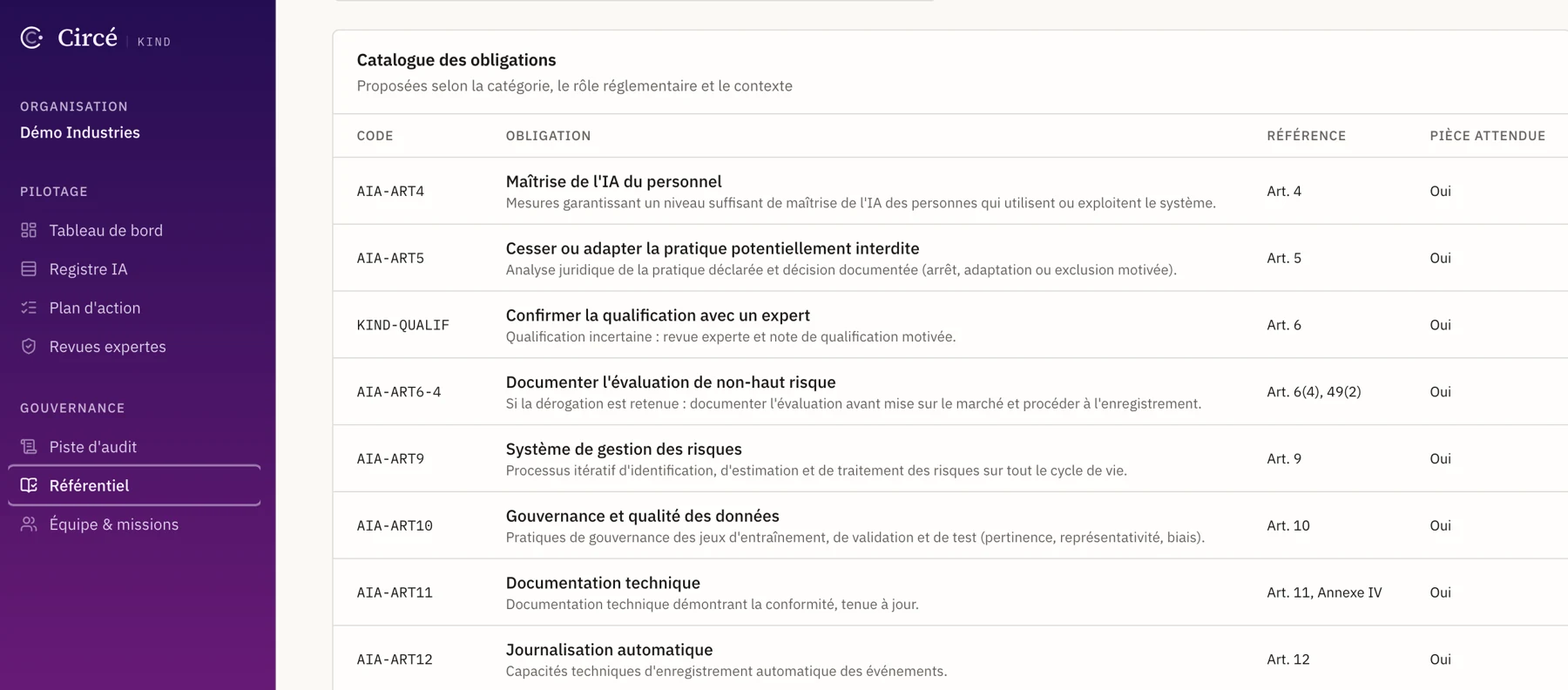
An obligations catalogue linked to the AI Act
Obligations are proposed according to the risk category, the regulatory role and the context. Each one carries a code, an article reference and the expected supporting document.
Circé proposes. An expert validates. The log records.
The AI Act calls for effective human oversight. Circé is built to make it demonstrable, not to replace it.
Circé proposes
From your answers and explicit rules, the platform proposes a qualification and the list of related obligations.
A KIND expert validates
A member of the KIND expert network checks uncertain or sensitive cases and issues a named decision.
The log records
Every action is timestamped and chained by SHA-256 fingerprint, tied to its author and to the system concerned.
The platform modules
Dashboard
Six work indicators and priority actions on a single screen.
AI register
Living inventory of systems, with qualification, review status and completeness.
System declaration
Guided form and automatic SIA-00X identifier.
AI Act qualification
17-question questionnaire and versioned explicit rules.
Action plan
Obligations by priority: late, blocked, missing document, no owner.
Supporting documents
Each obligation states the expected document. Gaps surface in the plan.
Expert reviews
Review requests, decisions made, reviewer and date.
Audit trail
Append-only log, chained by SHA-256, with integrity check.
Framework
Grid, rules, categories and obligations catalogue, with grid change tracking.
Obligations catalogue
Codes, article references and expected documents, depending on the system's context.
Team and missions
Administrator and contributor roles, obligation assignment, missions given to experts.
Exports
Register and log as CSV, PDF file per system with completeness and missing items.
Already in beta testing with a client.
Circé is not yet launched commercially. It is being tested in real conditions with a first client, and we are evolving the framework, the questionnaire and the action plan based on that field experience.
Want to see it run on one of your systems, or be told when it opens? Write to us.
One tool, five ways to save time
Secure your AI without slowing your growth.
Make your AI systems compliant without blocking your technical teams.
Take back control of the data your AI tools use.
Identify, prioritise and secure the AI uses in your organisation.
Turn regulatory obligations into an operational action plan.
What Circé does, and what it does not
Frequently asked questions
What is KIND Circé?
Circé is KIND's AI governance and compliance platform. It is used to declare your AI systems, propose their qualification under the AI Act, track the related obligations and keep a record of decisions, with review by a KIND expert available.
Does Circé decide for me?
No. Circé proposes qualifications based on explicit rules. No decision is delegated to an AI model, and validation stays human.
How does Circé qualify an AI system?
You describe the system, then answer a 17-question questionnaire. Explicit, versioned rules propose a level among prohibited practice, high risk, limited risk and minimal risk. If the qualification is uncertain, confirmation by an expert is requested.
Does Circé cover GDPR and ISO 42001?
Circé's current framework is centred on the AI Act (Regulation (EU) 2024/1689). GDPR and ISO 42001-type governance are handled in KIND's support offers, for example Conformité 360, and are not part of the platform's framework at this stage.
Is Circé available?
Circé is in beta testing with a client. It is not yet launched commercially. You can write to us for a demo or to be informed when it opens.
Are the screenshots real?
Yes, they are screenshots of the Circé platform, with demonstration data from a fictitious organisation.
Where is the data hosted?
On security, no data is transmitted outside the European Union and execution can take place in your own environment. The exact terms are to be defined with us according to your context.
Where does the AI Act timeline stand?
Prohibited practices and the AI literacy obligation (Article 4) have applied since 2 February 2025, rules on general-purpose AI models since 2 August 2025, transparency (Article 50) and the penalty regime since 2 August 2026. Under the Digital Omnibus, high-risk obligations of Annex III are postponed to 2 December 2027 and those of Annex I to 2 August 2028. To be checked against the official texts.
See Circé in action
A demo on one of your AI systems, with a KIND expert. Tell us what you use, and we show you how Circé qualifies it.
Screenshots of the Circé platform (interface currently in French) with demonstration data. Circé proposes qualifications based on explicit rules; they do not constitute legal advice and are not a compliance certification. Platform in beta testing, not yet launched commercially.